
What a good prune actually does
Pruning is not a haircut. Every cut is a wound the tree has to close, so the point is to make as few as possible and put each one in the right place — at the branch collar, no flush cuts, no stubs. Done right, the tree looks like nobody touched it and behaves better for years.
What we are usually taking out:
- Deadwood — the limbs that come down on their own, usually onto something
- Weight on the long ends — the reason big limbs tear out in a Hill Country downdraft
- Clearance — roof, gutters, driveway, pool, fence line and the drop to the house
- Rubbing and crossing limbs — the wounds a tree gives itself
- Structure on young trees — one leader, good spacing, decided early
Thinning, raising, reducing
Thinning opens the canopy so wind moves through instead of pushing against it. Raising lifts the lower limbs off the lawn, the drive and your head. Reduction shortens a limb back to a live lateral that can take over as the new end — that is how height comes off a tree without topping it.
What we will not do is top a tree. Cutting the crown back to stubs leaves wounds that cannot seal, invites decay into the trunk, and grows back as a thicket of weak shoots that is more dangerous than what was there before.
Oaks get treated differently
Oak wilt is endemic in Comal County, and it moves through fresh wounds. So oaks are pruned in the safe part of the calendar wherever the job can wait, and every single cut is painted immediately — no exceptions, no "we'll get it on the way out".
Storm-proofing before the season
The cheapest tree work you will ever pay for is the deadwood taken out before it lands on the roof. If a limb already has, that is a storm call instead.
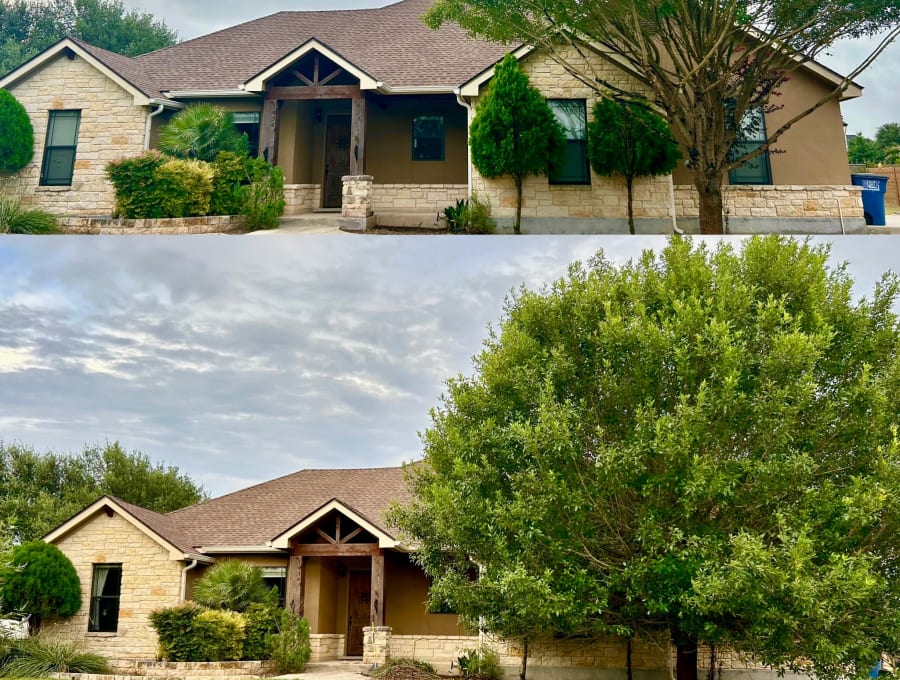 In the canopy
The standard
Cuts you would not notice.
- Collar cuts onlyNo flush cuts, no stubs left behind.
- Nothing over a quarterWe do not strip a canopy to make it look trimmed.
- Climbed, not spikedSpikes are for removals, not for a tree that stays.
- Oak cuts sealed on the spotEvery time, whatever the month.
- Brush chipped, lawn rakedThe clean-up is part of the job, not an extra.
Questions
Pruning, answered.
How often should a tree be pruned?
Most mature shade trees around here are fine on a three to five year cycle. Young trees benefit from a light structural prune more often than that, because it is far cheaper to shape a branch at two inches than to remove it at twelve.
When is the right time to prune an oak in Texas?
The safest window for oaks in this part of Texas is the cold of winter or the heat of mid to late summer. February through June is the high-risk stretch for oak wilt, so we avoid non-urgent oak pruning then — and whatever the date, every cut gets sealed right away.
Do you top trees?
No. Topping leaves stubs that cannot seal, invites decay and grows back weaker and denser than what was there before. If a tree genuinely has to come down in height there are better ways to reduce it, and sometimes the honest answer is removal instead.
Can you clear limbs off my roof and driveway?
Yes. Clearance pruning over roofs, drives, pools and fence lines is one of the most common calls we get, and it is usually a half-day job rather than a big one.

Before the next storm
Get the deadwood out first.
It is always cheaper than the call you make after it lands on the roof.